
UPSC CURRENT AFFAIRS — 18 NOVEMBER 2026
1. Forest Rights Act at 20: Titles Go Digital
(SOCIAL JUSTICE) (PIB) The Forest Rights Act, 2006 completes 20 years. To mark it, the Ministry of Tribal Affairs launched the National FRA Digital Platform during Janjatiya Gaurav Pakhwada (1–15 November 2026). It brings the entire claim chain, from Gram Sabha submission to digitally signed titles, onto one system.
Why the Law Was Needed
When State forests were consolidated in colonial times and after Independence, the customary rights of forest dwellers were rarely recorded. Communities living on ancestral land were treated as encroachers. The FRA corrects this historical injustice by legally recognising individual and community rights over forest land.
| Feature | Details |
|---|---|
| Full name | Scheduled Tribes and Other Traditional Forest Dwellers (Recognition of Forest Rights) Act, 2006 |
| Timeline | Presidential assent 29 December 2006; in force 31 December 2007; Rules notified 1 January 2008 |
| Nodal ministry | Ministry of Tribal Affairs; implemented by 20 States and 1 UT (Jammu and Kashmir) |
| Cut-off date | Occupation of forest land before 13 December 2005 |
| Ceiling | Land actually occupied, up to 4 hectares |
Who Can Claim
- Forest-Dwelling Scheduled Tribes (FDSTs): Scheduled Tribe members who primarily live in forests and depend on them for bona fide livelihood needs.
- Other Traditional Forest Dwellers (OTFDs): communities that have lived in and depended on forests for at least three generations (75 years) before the cut-off date.
Kinds of Rights and Titles
| Title / right | What it secures |
|---|---|
| Individual title | Land used for a home or cultivation (max 4 ha); issued jointly to spouses, or to a single head of household |
| Community forest rights | Shared uses such as grazing, fishing, water bodies and minor forest produce (bamboo, honey, lac, tendu leaves, medicinal plants) |
| Community forest resource (CFR) | Power of the Gram Sabha to protect, regenerate, conserve and manage the customary forest |
| Habitat rights | For PVTGs; granted to 11 PVTGs in Odisha, Chhattisgarh and Madhya Pradesh |
A title is heritable but not transferable. It is signed by three district officers: the Divisional Forest Officer, the District Tribal Welfare Officer and the District Collector. Community titles go to the Gram Sabha.
How a Claim Is Decided
The FRA makes the Gram Sabha, the assembly of all adult villagers, the starting point. This mirrors the spirit of the PESA Act, 1996 and grassroots Panchayati Raj.
Gram Sabha + Forest Rights Committee (10–15 members) ➜ Sub-Divisional Level Committee ➜ District Level Committee (final, binding) ➜ Entry in revenue & forest records
- Forest Rights Committee: at least two-thirds Scheduled Tribe members and at least one-third women.
- Appeal: a claimant can petition the next committee within 60 days, extendable by 30 days. Every rejection needs a reasoned order.
- Oversight: a State Level Monitoring Committee chaired by the Chief Secretary meets at least once a quarter.
Progress So Far
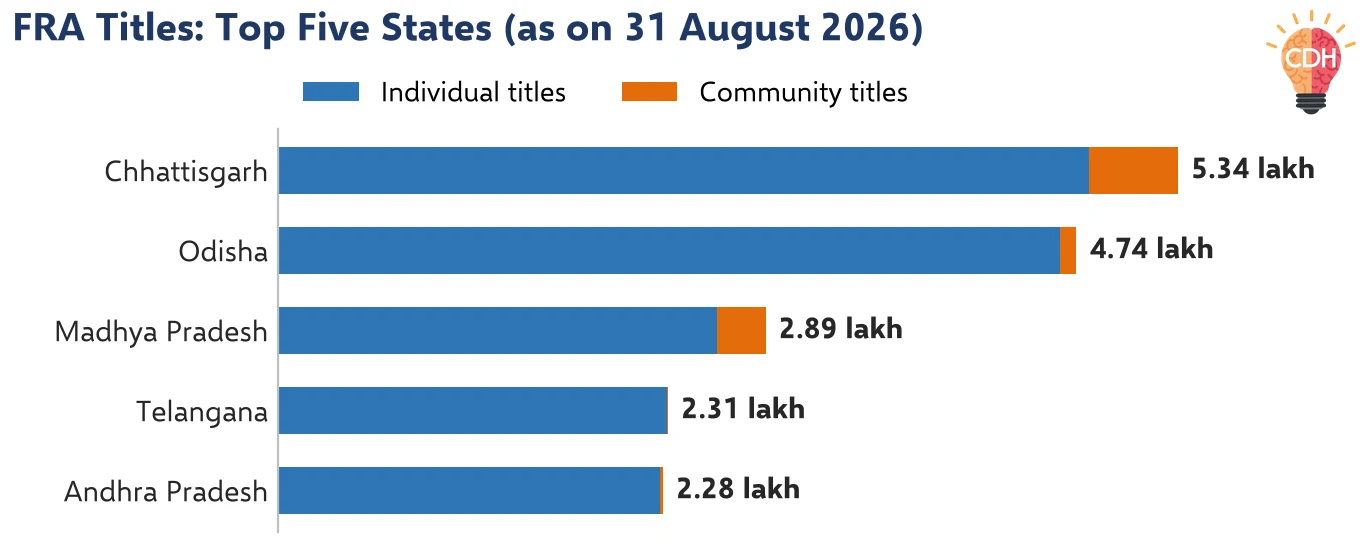
As on 31 August 2026, about 54 lakh claims were received and 43.56 lakh (80.64%) disposed of. 25.42 lakh titles have been distributed over nearly 238 lakh acres: 24.18 lakh individual and only 1.24 lakh community titles.
Support Measures
- DA-JGUA: funds State and district FRA cells for two years, plus ₹15 lakh per CFR Management Plan and ₹1 lakh for technical support.
- Revenue linkage: Maharashtra’s Forms 7E and 12E, Andhra Pradesh’s Giribhumi portal and Telangana’s BhuBharathi integration help titleholders access crop loans and DBT.
- Scheme convergence: titleholders are covered under PM-KISAN since 2019.
- Capacity building: free FRA courses on iGOT, the platform of Mission Karmayogi.
Gaps That Remain
- Skewed recognition: community rights lag far behind individual titles, limiting collective forest governance.
- Record entry: delays in entering titles into revenue records block access to credit and schemes.
- Rejections: high rejection rates and weak reasoning in orders undermine the right to appeal.
📖 Read More: Forest Rights Act, 2006 • Forest Governance and Legal Frameworks • Scheduled and Tribal Areas
2. India Votes No on UN Death Penalty Moratorium
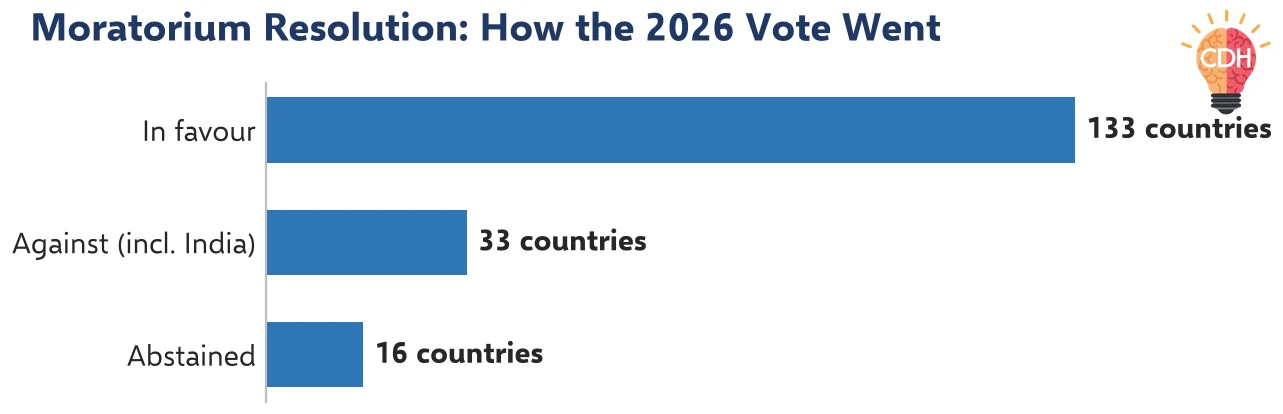
(POLITY AND GOVERNANCE) (IT) India and 32 other countries voted against a resolution, moved by Mexico, calling for a global moratorium on executions with a view to abolishing the death penalty. The vote on 13 November 2026 was in the UN General Assembly’s Third Committee; the full Assembly will take it up in December.
What the Resolution Says
- Sovereignty: reaffirms each country’s right to develop its own legal system and penalties, consistent with international law.
- Restriction: urges States to progressively reduce capital offences and remove mandatory death sentences.
- Protection: calls for no executions of pregnant women, older persons, or persons with mental or intellectual disabilities.
- Non-binding: like all General Assembly resolutions, it is recommendatory, but it shapes global norms.
India voted against alongside countries such as China, the United States, Japan, Saudi Arabia, Pakistan and Egypt. India’s consistent position is that sentencing is a sovereign matter and that its law already contains strong due-process safeguards.
Death Penalty in India
| Aspect | Position |
|---|---|
| Law | Retained for grave offences under the Bharatiya Nyaya Sanhita (BNS), 2023 and special laws |
| Doctrine | Bachan Singh v. State of Punjab (1980): life imprisonment is the rule, death only in the ‘rarest of rare’ cases |
| Confirmation | A Sessions Court death sentence must be confirmed by the High Court |
| Clemency | President under Article 72 and Governor under Article 161 |
| Reform view | 262nd Report of the Law Commission (2015): abolish except for terrorism and waging war |
The Debate
| Arguments for retention | Arguments for abolition |
|---|---|
| Deterrence and justice for the most heinous crimes | No conclusive evidence of greater deterrence than life imprisonment |
| Public sentiment and victims’ rights | Errors are irreversible; the poor face weaker legal defence |
| Sovereign right to decide penal policy | Long delays on death row cause added suffering |
📖 Read More: Bachan Singh Case (1980) • Pardoning Power of the President (Article 72) • The United Nations
3. RERA at Ten: Homebuyers Seek Sharper Teeth
(ECONOMICS) (IE) A decade after the Real Estate (Regulation and Development) Act, 2016, the homebuyers’ body Forum for People’s Collective Efforts (FPCE) has told the Prime Minister that the law has not met its objectives. The Cabinet Secretariat has since met the Forum to examine its proposals.
RERA in a Nutshell
RERA brought a largely unregulated sector under a regulator for the first time. It is administered by the Ministry of Housing and Urban Affairs (MoHUA) and is a key pillar of consumer protection in housing. The Act was passed in 2016 and came fully into force on 1 May 2017.
| Provision | What it requires |
|---|---|
| Registration (Sec 3) | Register with RERA before advertising or selling; exempt if land ≤ 500 sq m or ≤ 8 apartments |
| Escrow (Sec 4(2)(l)(D)) | 70% of buyers’ money in a separate bank account, used only for land and construction |
| Advance cap (Sec 13) | Not more than 10% of cost before a registered agreement for sale |
| Carpet area | Sale only on net usable carpet area |
| Defect liability | Structural defects reported within 5 years fixed free within 30 days |
| Delay remedy (Sec 18) | Exit with full refund and interest, or stay and get interest for each month of delay |
| Penalty (Sec 59) | Up to 10% of project cost for non-registration; up to 3 years’ jail for continued violation |
Institutional Framework
Homebuyer complaint ➜ State RERA (decide within 60 days) ➜ Real Estate Appellate Tribunal ➜ High Court
A Central Advisory Council (Sec 41), chaired by the Union Housing Minister, advises the Centre on implementation. Appellate bodies follow the general model of tribunals in India.
A Decade’s Scorecard
The Economic Survey 2024-25 counted about 1.38 lakh registered projects and 1.38 lakh resolved complaints; industry estimates now put both above 1.5 lakh. Yet recovery of refund orders is weak, appellate posts lie vacant, and several regulators are headed by retired bureaucrats.
Reforms Proposed by Homebuyers
- National Appellate Tribunal: one tribunal, on the lines of the NCLAT, for uniform interpretation, with appeals going directly to the Supreme Court.
- Statutory Agreement for Sale: move the model agreement from the Rules into a Schedule of the Act, making it binding.
- Buyer-initiated exit: allow withdrawal for personal hardship such as job loss or death of an earning member.
- Automatic compensation: pay delay compensation to all allottees in defaulting projects without individual suits.
- Realignment: shift homebuyer protection to the Department of Consumer Affairs, keep sector promotion with MoHUA, and audit State RERAs regularly.
📖 Read More: Consumer Protection • Consumer Commissions • Tribunals
4. Manila Summits: India Deepens Act East Ties
(INTERNATIONAL RELATIONS) (PIB) (DD) The Prime Minister attended the 23rd ASEAN–India Summit and the 21st East Asia Summit (EAS) in Manila, Philippines (16–17 November 2026). The Philippines chairs ASEAN in 2026 under the theme ‘Navigating Our Future, Together’. India announced nine ASEAN initiatives and four EAS initiatives.
Outcome Documents
- ASEAN–India Joint Statement on Cooperation in Disaster Management, linking ASEAN’s disaster bodies with India’s NDMA.
- EAS Leaders’ Statement on cooperation against online scams and related offences.
- EAS Declaration on ‘Navigating our Future, Together: Stability and Renewal’.
India’s Announcements
| At the ASEAN–India Summit | At the East Asia Summit |
|---|---|
| Long-term Maritime Cooperation Plan (connectivity, research, Coast Guards, maritime domain awareness) | Seafarers’ Safety Initiative for joint training and emergency response |
| Joint Cyber Forensics Training Programme; Nuclear Energy Technical Exchanges | EAS Cyber Crime Conference at National Forensic Sciences University |
| Space Hackathon; cooperation on mining and critical minerals | EAS Maritime Heritage Festival at Lothal, Gujarat |
| Youth Connect; more scholarships at Nalanda University | EAS University Conclave at Nalanda |
| Creative Partnership Pavilion at WAVES 2027; free e-visa for ASEAN tourists | — |
Know the Groupings
| Feature | ASEAN | East Asia Summit |
|---|---|---|
| Founded | 8 August 1967, Bangkok Declaration | 2005, Kuala Lumpur (India a founding member) |
| Members | 11, after Timor-Leste joined in 2025 | 19: ASEAN-11 + Australia, China, India, Japan, New Zealand, South Korea, Russia, US |
| Nature | Regional organisation; Secretariat in Jakarta | Leaders-led, ASEAN-centred strategic forum |
Why ASEAN Matters to India
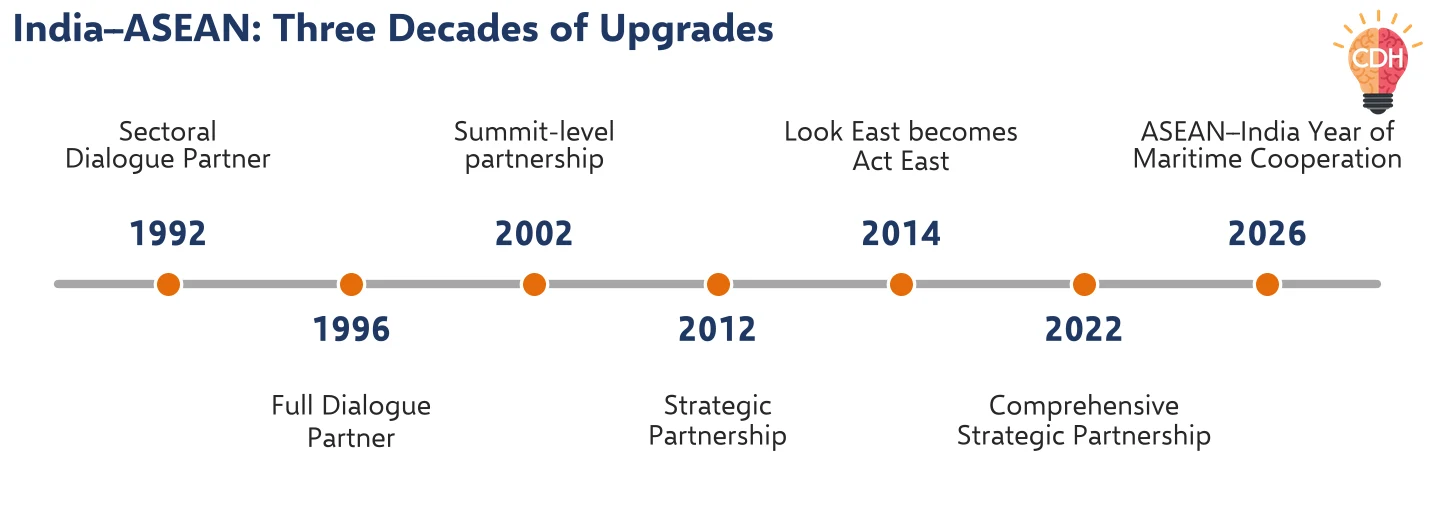
- Act East anchor: ASEAN is the core of India’s South-East Asia policy, built on Culture, Commerce, Connectivity and Capacity building.
- Maritime security: sea lanes through the Malacca Strait and South China Sea carry a large share of India’s trade; 2026 is the ASEAN–India Year of Maritime Cooperation.
- Northeast connectivity: projects such as the India–Myanmar–Thailand Trilateral Highway and the Kaladan project link the Northeast to South-East Asia via Myanmar.
- Indo-Pacific vision: India’s Indo-Pacific Oceans Initiative aligns with the ASEAN Outlook on the Indo-Pacific (AOIP).
Persisting Challenges
- Trade deficit: the review of the ASEAN–India Trade in Goods Agreement (AITIGA) is still pending.
- Slow connectivity: instability in Myanmar has stalled overland corridors.
- China’s weight: deep economic dependence on China limits a common ASEAN line on maritime disputes.
📖 Read More: ASEAN • India and South-East Asia Policy • Maritime Foreign Policy Strategy
5. Quad Manila Summit Delivers Five Initiatives
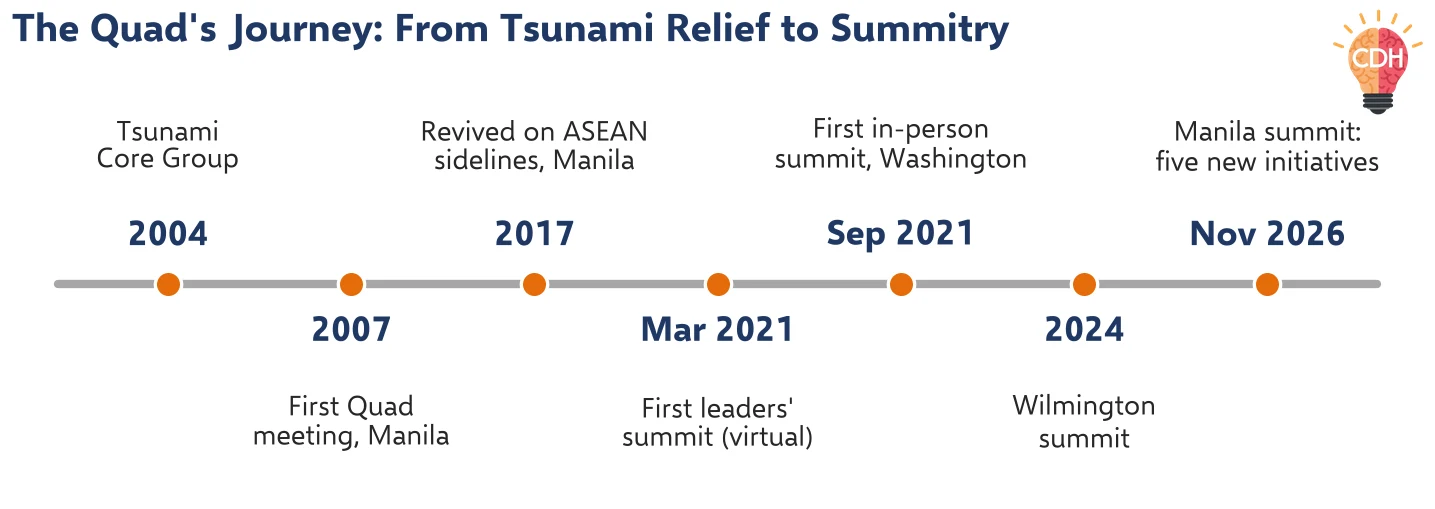
(INTERNATIONAL RELATIONS) (IE) Leaders of India, the US, Japan and Australia met in Manila on the sidelines of the East Asia Summit. It was the first Quad Leaders’ Summit since 2024 and the first hosted in a non-member country. The joint statement opposed any change to the status quo by force or coercion and condemned cross-border terrorism.
What Was Announced
| Initiative | Key details |
|---|---|
| Quad Business Leaders’ Forum | Inaugural edition in Mumbai in early 2027, to deepen private-sector ties and commercial deals |
| Quad AI Accelerator | Coordinates and funds trusted AI access, deployment and technical help across the Indo-Pacific |
| Indo-Pacific Maritime Surveillance Collaboration | Shared maritime domain awareness; P-8 and P-3C patrol aircraft to fly a Quad exercise for the first time in 2027 |
| Enhanced Cybersecurity Cooperation | Response to the rising number and scale of cyber incidents in the region |
| Counter-terrorism | Unequivocal condemnation of terrorism, including cross-border terrorism |
The maritime surveillance collaboration builds on an initiative first unveiled at the Quad Foreign Ministers’ meeting in New Delhi in May 2026. Leaders also highlighted new critical minerals arrangements to reduce exposure to coercion by any single supplier.
Significance for India
- Strategic autonomy: deep partnerships with the US, Japan and Australia without a military alliance.
- Maritime edge: stronger surveillance of the Indian Ocean and support for coastal and maritime security.
- Terror framing: explicit Quad language on cross-border terrorism supports India’s position on Pakistan-sponsored terror.
- Investment pull: hosting the first Business Leaders’ Forum positions Mumbai as a Quad economic hub.
Limitations
- Thin institutions: no secretariat or treaty, so momentum depends on four governments’ political will.
- Diverging priorities: different trade links with China and India’s ties with Russia complicate consensus.
📖 Read More: Holding the Quad Together Amid Strategic Drift (16 Nov 2026) • India–China Relations
6. Ganga Water Treaty Nears Expiry
(INTERNATIONAL RELATIONS) (TH) The 1996 India–Bangladesh Ganga Water Treaty expires in December 2026, after its 30-year term. With barely four weeks left, experts in Bangladesh are urging a temporary renewal for three to five years, as a full revision is not possible in time.
The Treaty at a Glance
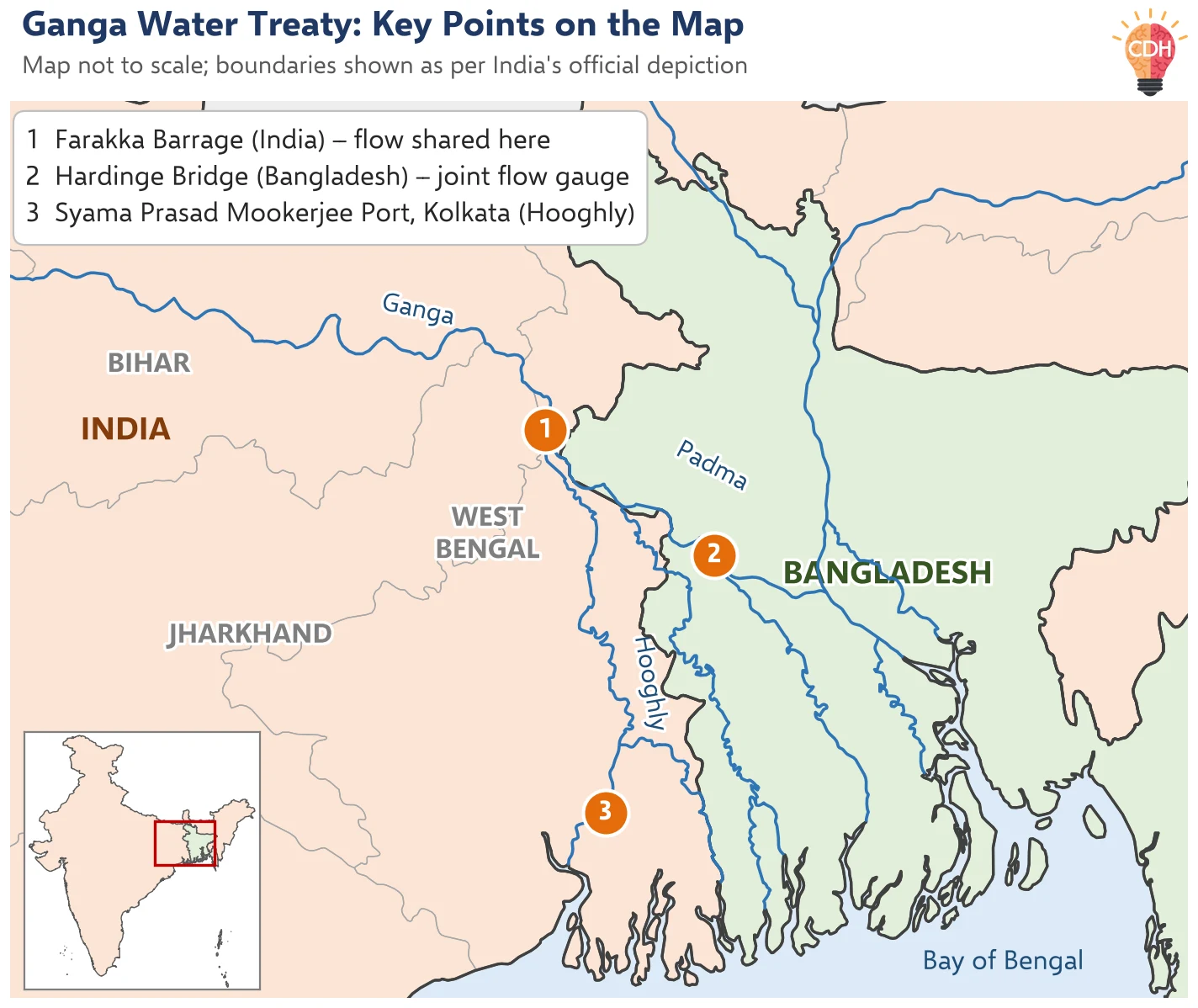
The treaty was signed on 12 December 1996 by Prime Ministers H.D. Deve Gowda and Sheikh Hasina. It governs how the Ganga’s lean-season flow at Farakka Barrage is shared from 1 January to 31 May, in 10-day periods. It runs for 30 years and can be renewed only by mutual consent.
| Flow at Farakka | India’s share | Bangladesh’s share |
|---|---|---|
| 70,000 cusecs or less | 50% | 50% |
| 70,000–75,000 cusecs | Balance of flow | 35,000 cusecs |
| 75,000 cusecs or more | 40,000 cusecs | Balance of flow |
- Guarantee: each side gets an assured 35,000 cusecs in alternate three 10-day periods between 11 March and 10 May.
- Emergency clause: if flow falls below 50,000 cusecs, both governments must hold immediate consultations.
- Monitoring: a Joint Committee records daily flows at Farakka and at Hardinge Bridge in Bangladesh.
- Disputes: go to the Indo-Bangladesh Joint Rivers Commission (1972) and then to the two governments; there is no third-party arbitration.
Why Renewal Is Complicated
- Old hydrology: the indicative schedule rests on 1949–1988 average flows, ignoring climate variability and heavy siltation in the Ganga basin.
- Domestic stakes: West Bengal needs lean-season flows to keep the Hooghly navigable for Kolkata port; Bihar links the barrage to upstream siltation and floods.
- Weak guarantee: Bangladesh wants a firmer minimum-flow clause like the one in the 1977 Farakka Agreement.
- Lapse risk: without a treaty, India has no obligation to release water before Bangladesh’s February irrigation season, as during the 1988–1996 gap.
The treaty is a benchmark for South Asian river water diplomacy. Its fate will also shape talks on the pending Teesta water-sharing deal.
📖 Read More: India and Bangladesh • Ganga River System • River Water Disputes
7. India–Egypt Trade Talks Go Ministerial
(INTERNATIONAL RELATIONS) (PIB) The 7th India–Egypt Joint Trade Committee (JTC) met in Egypt’s New Administrative Capital on 16 November 2026. It was the first time the mechanism met at ministerial level. Both sides agreed to set up a Joint Working Group to frame terms of reference for a Preferential or Free Trade Agreement.
Key Outcomes
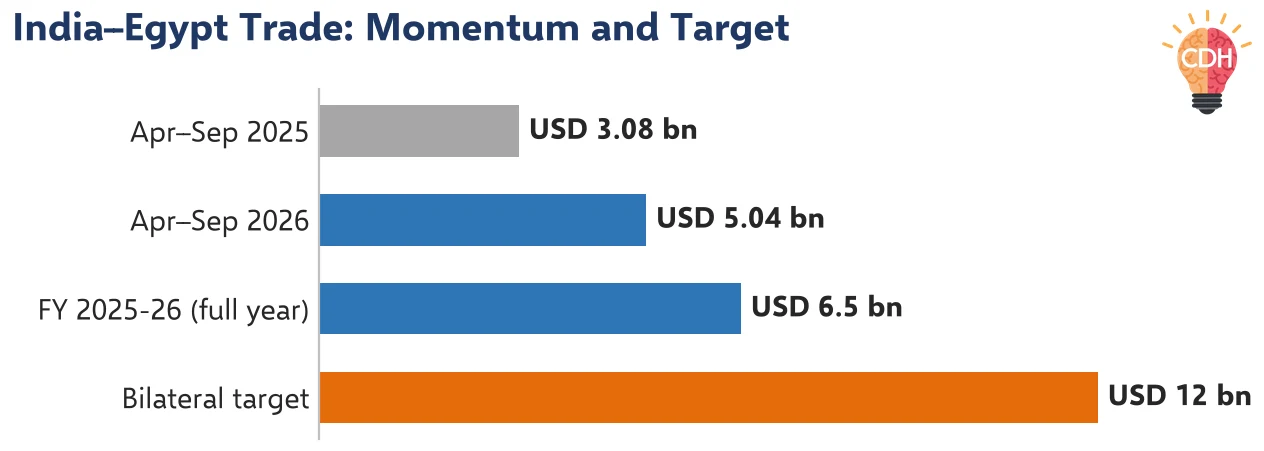
- Trade growth: bilateral trade rose 35% to USD 6.5 billion in FY 2025-26; April–September 2026 trade grew 65% to USD 5.04 billion.
- Trade agreement: a Joint Working Group will explore a PTA or FTA (see types of trade agreements).
- Investment link: strengthen the framework between Invest India and Egypt’s General Authority for Investment and Free Zones (GAFI).
- Business forum: over 300 companies took part in the India–Egypt Business Forum.
- Next JTC: New Delhi, 2028, or earlier by mutual consent.
Five Areas of Complementarity
| Sector | Opportunity |
|---|---|
| Pharma and health | India’s affordable medicines, vaccines and medical technology |
| Engineering and autos | Machinery, auto components, industrial manufacturing |
| Agriculture and food | Food security, fertilisers, irrigation, cold chains |
| Digital and fintech | UPI linkages, local-currency trade, Digital Public Infrastructure |
| Culture and museums | Grand Egyptian Museum and India’s Yuge Yugeen Bharat museum on conservation and digitisation |
Why Egypt Matters
Egypt sits astride the Suez Canal, the gateway between India and European markets. Its access to African, Arab and European markets makes it a natural base for export-oriented Indian manufacturing. Ties were raised to a Strategic Partnership in 2023, and 2027 marks 80 years of diplomatic relations.
📖 Read More: India and Egypt Relations • Suez Crisis of 1956
8. India–Belarus Commission Charts 2027–31 Roadmap
(INTERNATIONAL RELATIONS) (PIB) The 12th Session of the India–Belarus Inter-Governmental Commission (IGC) on Trade, Economic, Scientific, Technological and Cultural Cooperation met in New Delhi on 16 November 2026. Both sides discussed a Roadmap for Cooperation 2027–2031 and signed the Protocol of the session.
| Item | Details |
|---|---|
| Co-chairs | India’s MoS Commerce and Industry Jitin Prasada and Belarus’s Foreign Minister Maxim Ryzhenkov |
| Priority sectors | Industry, banking, agriculture and food processing, pharmaceuticals, healthcare, education, tourism, culture, S&T, construction, customs |
| Technology areas | Digital technologies, advanced manufacturing, chemicals, mining equipment, unmanned aerial systems |
| Side event | India–Belarus Business and Investment Forum: joint ventures, technology transfer, localised manufacturing |
| Next session | 13th IGC in 2027 |
Why It Matters
- Eurasian outreach: Belarus is a member of the Eurasian Economic Union, a bloc with which India is exploring deeper trade ties.
- Industrial fit: Belarus is strong in heavy vehicles, agricultural machinery and potash fertilisers; India offers scale and services.
- Diversification: a five-year roadmap gives a long-term frame to a modest but steady partnership.
9. Voyager 1 Nears One Light-Day From Earth
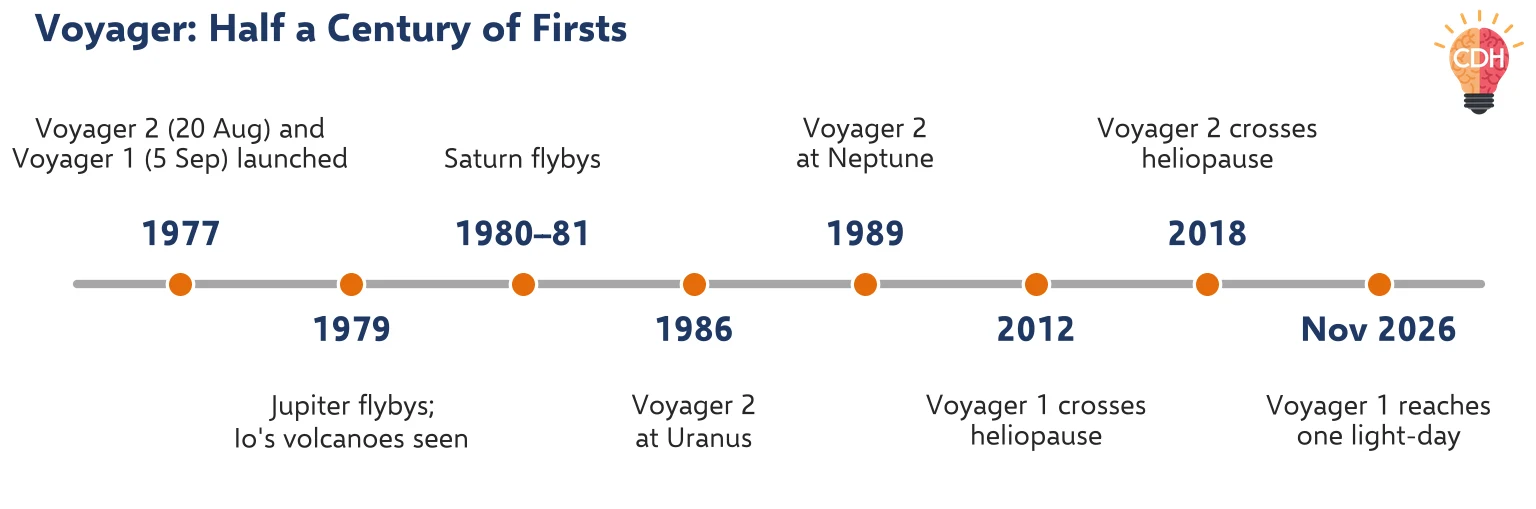
(SCIENCE AND TECHNOLOGY) (DTE) NASA’s Voyager 1, launched in 1977, is set to become the first human-made object to reach one light-day from Earth in November 2026. It is already the farthest spacecraft from Earth and has been travelling through interstellar space since 2012.
What Is a Light-Day?
A light-day is a unit of distance, not time: the distance light travels in a vacuum in one day. That is roughly 25.9 billion km, or about 173 astronomical units (AU). A radio command sent today will take a full day to reach the spacecraft.
The Voyager Mission
- Twin probes: Voyager 1 and Voyager 2 were launched to explore the giant outer planets through close flybys.
- Grand Tour: a rare alignment of Jupiter, Saturn, Uranus and Neptune (about once in 175 years) allowed one craft to visit all four.
- Gravity assist: each flyby used a planet’s gravity to speed up and bend the probe’s path, saving fuel (see gravitation and planetary motion).
- Power: three radioisotope thermoelectric generators (RTGs) per craft turn heat from plutonium-238 decay into electricity.
Voyager 1 vs Voyager 2
| Basis | Voyager 1 | Voyager 2 |
|---|---|---|
| Launch | 5 September 1977 | 20 August 1977 |
| Planets | Jupiter, Saturn (and Saturn’s moon Titan) | Jupiter, Saturn, Uranus, Neptune: the only craft to visit the last two |
| Highlight | First active volcanoes beyond Earth, on Jupiter’s moon Io | New moons of Uranus; Neptune’s Great Dark Spot |
| Heliopause | Crossed in 2012: first object in interstellar space | Crossed in 2018 |
Heliosphere and Heliopause
The solar wind from the Sun blows a vast bubble called the heliosphere around the Solar System. Its outer edge, the heliopause, is where the solar wind meets the interstellar medium. Both Voyagers now sample this medium directly.
With power falling each year, engineers are switching off instruments one by one to keep the probes alive. Both also carry the Golden Record, a message about life on Earth.
📖 Read More: Solar, Lunar and Planetary Exploration • Planets of our Solar System • Components of the Solar System
10. Dancing Girl to Move to Yuge Yugeen Bharat
(ART AND CULTURE) (TH) The 4,500-year-old ‘Dancing Girl’ of Mohenjo-daro will move from the National Museum to the first gallery of the upcoming Yuge Yugeen Bharat Museum in New Delhi. The Nizam’s jewels, Taxila jewellery, the Gandhara collection and miniature paintings will join it in the ‘Adornments’ gallery.
The Dancing Girl
| Feature | Details |
|---|---|
| Find | Excavated in 1926 by Ernest Mackay in the ‘HR area’ of Mohenjo-daro (Sindh, present-day Pakistan) |
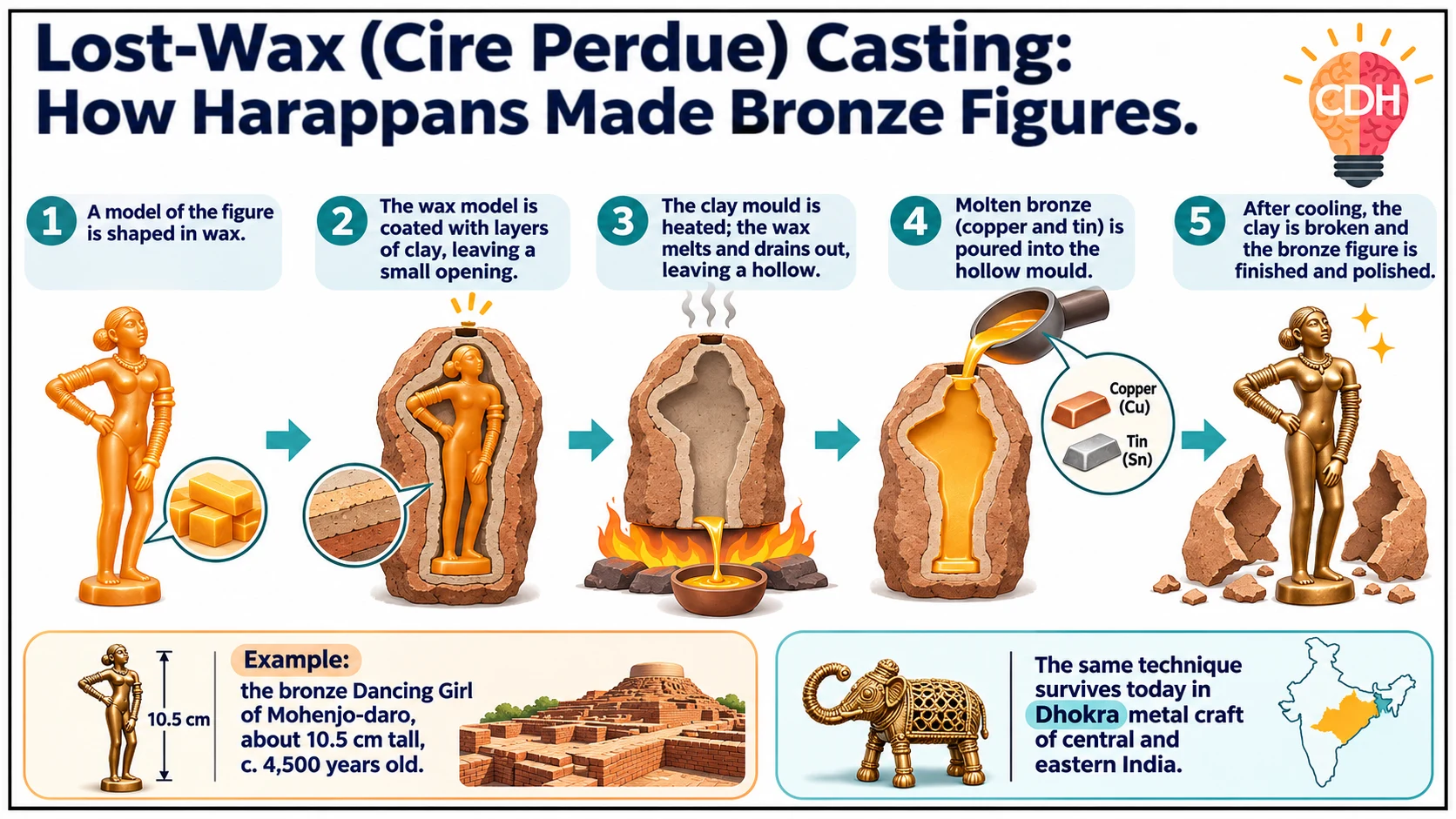
| Material and size | Bronze; only about 10.5 cm tall |
| Ornaments | 24–25 bangles on the left arm, 4 on the right, and a necklace with three large pendants |
| Significance | Shows Harappan metallurgy, jewellery traditions and aesthetic sense; the dance posture is an interpretation |
It is the finest surviving example of Indus Valley sculpture in metal. It reflects the advanced craft of the Harappan civilisation.
How It Was Made: Lost-Wax Casting
Wax model ➜ Coated with clay ➜ Heated; wax drains out ➜ Molten bronze poured in ➜ Clay broken; figure finished
The same cire perdue technique survives today in Dhokra metal craft of central and eastern India (see metallurgy).
Yuge Yugeen Bharat Museum
- Location: the historic North and South Block buildings, freed after government offices moved out; an example of adaptive reuse.
- Scale: planned to have the largest display area of any museum in the world, at an estimated cost of ₹3,230 crore.
- Concept: a civilisational museum tracing over 5,000 years of continuity, unlike the National Museum, which is historical.
- First gallery: ‘Adornments’, featuring the Dancing Girl, Nizam’s jewels, Gandhara art and miniature paintings.
📖 Read More: Sculpture of the Indus Valley Civilisation • Indus Valley Civilisation • Safeguarding India’s Art Heritage
11. Remembering Kartar Singh Sarabha, Ghadar’s Youngest Martyr
Role in the Freedom Struggle
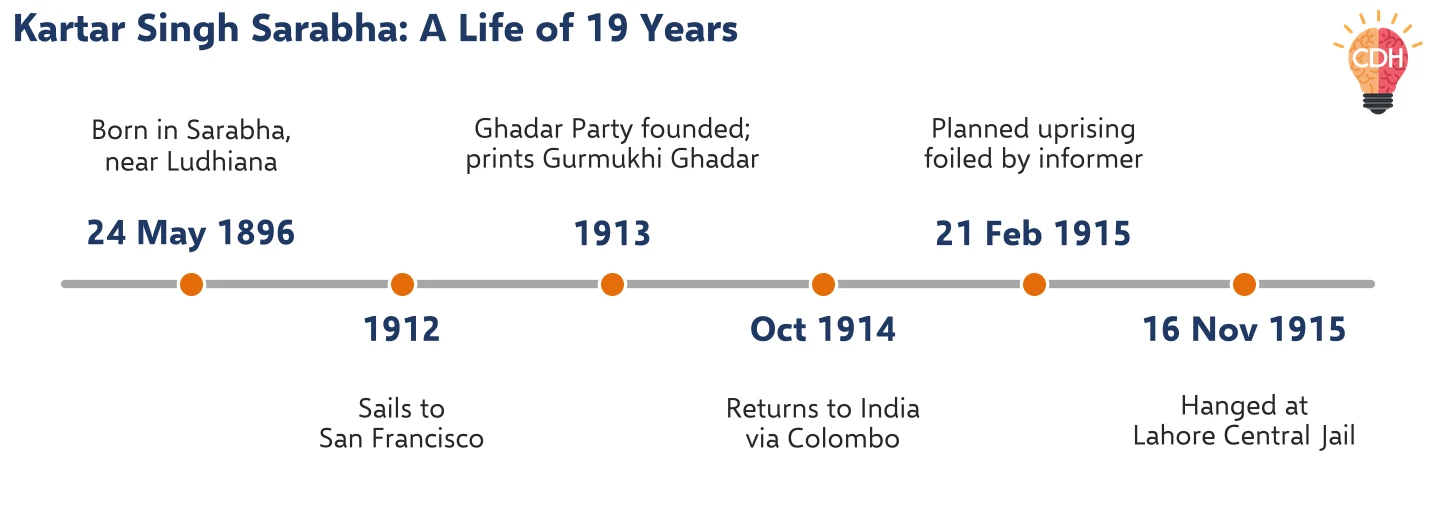
- Ghadar Party: joined the Ghadar Party, founded in 1913 in the US with Sohan Singh Bhakna as president and Lala Har Dayal as secretary, to end British rule by armed revolt.
- Ghadar newspaper: printed its Gurmukhi (Punjabi) edition and wrote fiery articles and poems for overseas Indians.
- Return: after the First World War broke out, he returned in 1914 to organise a mutiny among Indian soldiers, working with Rash Behari Bose.
- Failed rising: the uprising set for 21 February 1915 was betrayed by an informer; he was arrested in March 1915.
- Martyrdom: sentenced in the First Lahore Conspiracy Case and hanged at Lahore Central Jail in November 1915.
Legacy
Sarabha became an icon of revolutionary nationalism. Bhagat Singh regarded him as a hero and is said to have carried his photograph. The Ghadar movement showed that the freedom struggle had a strong diaspora and secular, internationalist character.
📖 Read More: The Ghadar Movement • Rise of Revolutionary Nationalism